
Camels in Palestine

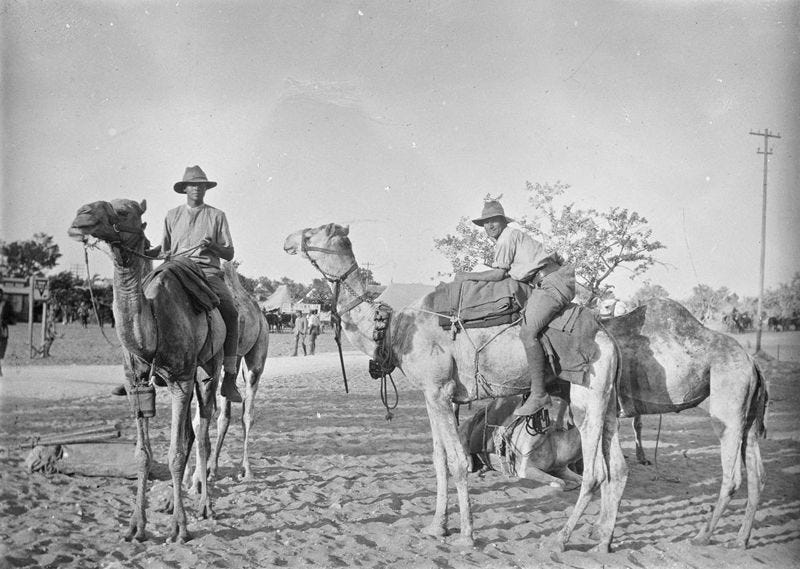
Photo: https://www.iwm.org.uk/history/10-incredible-photos-of-the-imperial-camel-corps
Men of an ANZAC Battalion of the Imperial Camel Corps Brigade at Ludd, 1918.
Once you’ve seen David Lean’s epic masterpiece, Lawrence of Arabia, it’s hard not to imagine a great, roaring camel charge across the desert.
The camels of the Imperial Camel Corps usually had much more mundane duties. They were beasts of transport, carrying supplies, water, machine guns, and the sick and wounded.
There’s a photo on the NZ history website, https://nzhistory.govt.nz/media/photo/transporting-camels-train of camels loaded on a train in wagons for transport on the Sinai railway in 1917. They are neatly lined up, like a toy railway with a circus. Each camel seems calm in this strange conveyance, and I wonder how they viewed the world as the train carried them sideways across the land.
Given camels’ reputation for bad temper and stubbornness, it would have been a difficult undertaking to load (and unload) this cargo. But the men of the Imperial Camel Corps did admire their mounts’ toughness and resilience, their ability to travel for days without water and carry heavier loads than horses.
The Imperial Camel Corps Brigade was formed in December 1916, growing to four battalions, one from Great Britain, one from New Zealand and two from Australia. Some of the Australians had come from the failed Gallipoli Campaign. The first camels came from India, but later Egyptian camels were used for carrying troops, while the heavier Indian camels were used for transport. One story tells how the men selected for the Camel Corps were often the most difficult and troublesome, and so removed from their original roles.
The Australian War Memorial website says,
“The men of the ICC had a rough reputation, largely because when the Corps was originally formed Australian battalion commanders had seized upon it as an opportunity to offload some of their more difficult characters. In 1917 a British supply dump at Rafa was warned to double their guards as the ICC was going to be camped nearby.
“The men of the ICC were, however, resourceful and effective. While defending a hill called Musallabeh in April 1918, some Australians of the ICC ran out of hand grenades. They resorted to heaving boulders down upon the attacking Turks and eventually fought them off. The hill became known as the ‘Camel’s Hump’.”
https://www.awm.gov.au/collection/U51065
The love-hate relationship between the Britsh soldier and the camel goes back to India, where the camel is called a oont (or unt). Rudyard Kipling wrote about the oonts in 1890.
“The ’orse ’e knows above a bit, the bullock’s but a fool,
The elephant’s a gentleman, the battery-mule’s a mule;
But the commissariat cam-u-el, when all is said an’ done,
’E’s a devil an’ a ostrich an’ a orphan-child in one.
O the oont, O the oont, O the Gawd-forsaken oont!
The lumpy-’umpy ’ummin’-bird a-singin’ where ’e lies,
’E’s blocked the whole division from the rear-guard to the front,
An’ when we get him up again - the beggar goes an’ dies!”
For all that, when the Camel Corps was disbanded in 1918, the cameleers discovered that they would miss them after all.
Major Oliver Hogue continues: “then, suddenly…we began to realise some of the many virtues of the much-maligned camel…The reason for this volte-face, this sudden revulsion of feeling in favour of the camel, lay in the fact our camels were to be taken away from us.” Once word spread that the ICC was to be disbanded, many cameleers thought more kindly of their camels and realised the little luxuries they were afforded: the extra blankets and rations that could fit in a camel saddle, the reduced hours spent feeding, watering and grooming their mounts, and of course, the camel sports. The soldiers were not without sympathy for their camels, who had trekked through the desert alongside them and similarly suffered the hardships of desert campaigns. As such, Trooper Frank Reid noted that “we were sorry for the camels. Although we often cursed them, when they were to be taken away from us, we found that we had become quite attached to our ugly, ungainly mounts…we reckoned they were entitled to a long spell in country.”
https://www.slq.qld.gov.au/BLOG/BUMPY-HISTORY-IMPERIAL-CAMEL-CORPS-WWI
After June 1918 when the Australians and New Zealanders left the ICC six British companies remained. Some of these rode their camels into history and film legend as they fought with Lawrence of Arabia in the Arab Revolt, and carried out operations sabotaging the Hejaz railway line in July 1918. The ICC was eventually disbanded in May 1919.